Экономическая историЯ
Russian Journal of Economic History
ISSN 2409-630X (Print)
ISSN 2618-916X (Online)

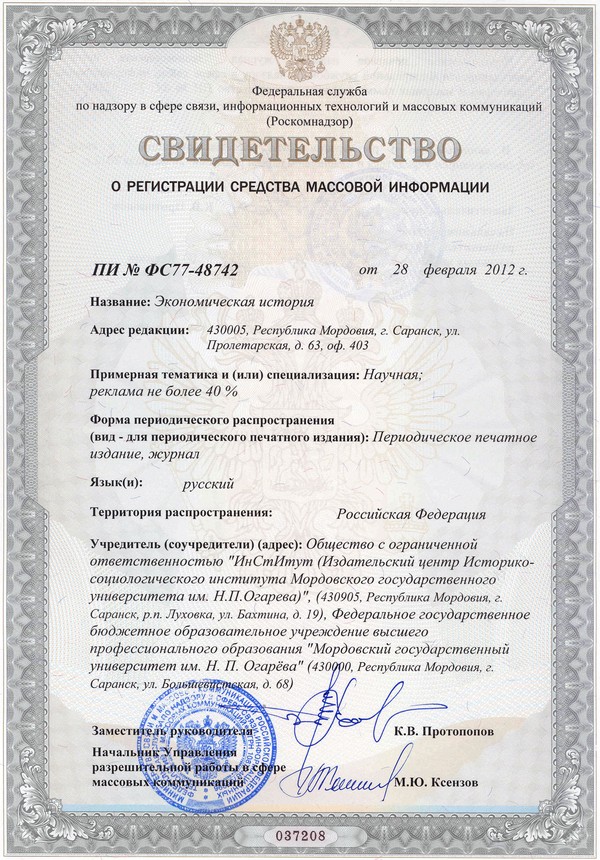
Certificate of registration
Expert board:
- Scientific Council of RAS on economic history;
- Research and Educational Center «The economic history of Central Russia and the Middle Volga region» of Ogarev Mordovia State University;
- Center of Economic History of Lomonosov Moscow State University
Navigation
ISSN 2409-630X (Print), ISSN 2618-916X (Online)
DOI: 10.24412/2409-630X.072.022.202601.009-024
УДК 94(470/5)
Nikolay M. Arsentiev1, Anatoly V. Sludnykh2, Ekaterina A. Averyanova3
1 Institute of Oriental Studies Russian Academy of Science (Moscow, Russia),
e-mail: director_isi@bk.ru
2 Ural Optical and Mechanical Plant named after E. N. Yalamov (Ekaterinburg, Russia),
e-mail: sludnichav1982@inbox.ru
3 National Research Ogarev Mordovia State University (Saransk, Russia),
e-mail: averyanova-morm@mail.ru
International Cooperation of Scientists of the State Optical Institute in the 1930s
Abstract
Introduction. The international cooperation of the State Optical Institute (SOI) in the 1930s is of particular interest for studying the history of scientific diplomacy. The research is based on unique archival materials and published sources that reveal the mechanisms of interaction between Soviet and foreign scientists.
The relevance of the topic is determined by the increased role of international scientific cooperation in the modern world. The analysis of the SOI experience helps to understand how international relations in optical science were formed and which models of interaction proved to be the most effective.
The research contributes to understanding how scientific cooperation contributed to the development of optical science in the pre-war period and what lessons can be learned for modern international scientific projects.
Results and Discussions. The study identified some key areas of SOI international cooperation in the 1930s, characterized primarily by bilateral cooperation with scientific centers in Germany, France, the United States, Great Britain, Holland, and others. It was established that the main forms of cooperation were business trips abroad, exchange of specialists, joint research in the field of optical and mechanical instrumentation.
The analysis of archival materials allowed us to determine the significant role of foreign specialists in the development of the institute’s experimental base. It is revealed that international cooperation has contributed to the introduction of advanced optical production technologies and the modernization of the SOI research infrastructure.
Conclusion. Scientific cooperation was mainly of an applied nature, aimed at solving practical problems in the optical industry. The interdependence between the expansion of international cooperation and the improvement of the quality of optical research in the pre-war period has been established. International cooperation has also become an important factor in the development of optical science in the USSR, contributing to technological progress and the formation of the scientific potential of the institute.
Keywords: scientific international cooperation in the 1930s, foreign specialists, State Optical Institute, optical science, scientific and technical cooperation, optical and mechanical industry of the USSR, scientific research, technological development, optical devices.
For citation: Arsentiev N. M., Sludnykh A. V., Averyanova E. A. International Cooperation of Scientists of the State Optical Institute in the 1930s. Ekonomicheskaya istoriya = Russian Journal of Economic History. 2026; 22(1): 9–24. (In Russ.) DOI: 10.24412/2409-630X.072.022.202601.009-024.
© Ogarev Mordovia State University. History and Sociology Institute, 2017
68, Of. 411, Bolshevistskaya St., 430005, The editorial office of the scholarly journal «Russian Journal of Economic History»
Tel.: (8342) 24-25-90; 27-07-11, Fax: (8342) 24-25-90, E-mail: jurnal-econom-hist@isi.mrsu.ru
Designed by A. Napalkov, Email: napalkov@isi.mrsu.ru