Экономическая историЯ
Russian Journal of Economic History
ISSN 2409-630X (Print)
ISSN 2618-916X (Online)

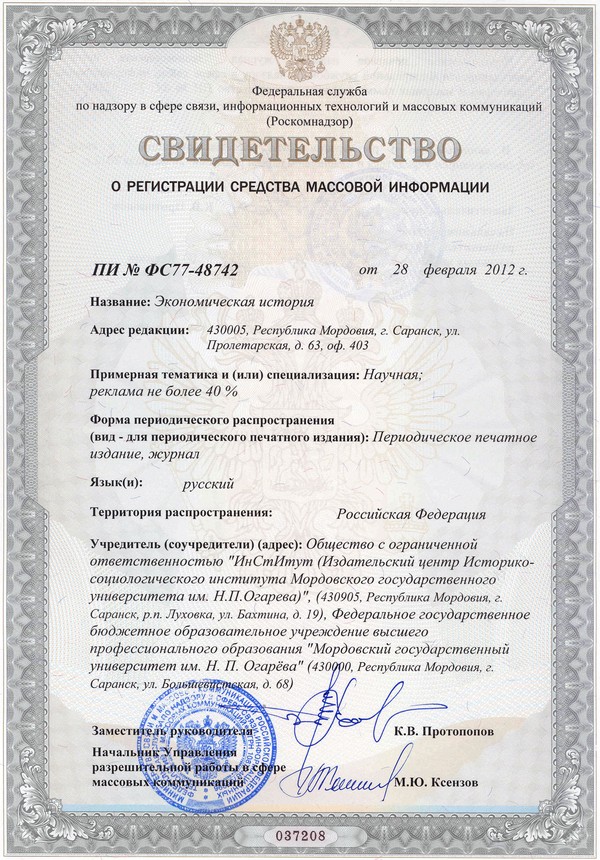
Certificate of registration
Expert board:
- Scientific Council of RAS on economic history;
- Research and Educational Center «The economic history of Central Russia and the Middle Volga region» of Ogarev Mordovia State University;
- Center of Economic History of Lomonosov Moscow State University
Navigation
ISSN 2409-630X (Print), ISSN 2618-916X (Online)
DOI: 10.24412/2409-630X.071.021.202504.387-412
Nikolay M. Arsentyev1, Anatoly V. Sludnyh2, Ekaterina A. Averyanova3,
1 Chief Scientific Officer, Institute of Oriental Studies, Russian Academy of Sciences, Editor-in-Chief of the journals “Russian Journal of Economic History”, “Russian Journal of the Humanities” (Saransk, Russia),
е-mail: direktor_isi@bk.ru
2 Ural Optical and Mechanical Plant named after E. S. Yalamov (Ekaterinburg, Russia),
e-mail: sludnichav1982@inbox.ru
3 National Research Ogarev Mordovia State University (Saransk, Russia), (Saransk, Russia),
e-mail: averyanova-morm@mail.ru
The March (1936) Session of the USSR Academy of Sciences and the Activities of the State Optical Institute
Abstract
Introduction. The article is devoted to the study of the role of science in carrying out the “Stalinist industrialization”. In the mid-1930s, the USSR Academy of Sciences was strengthened as the central governing body of science. The Seventh Congress of the CPSU(b), held in 1934, linked the completion of the technical reconstruction of the entire economy and the technical modernization of industry precisely with science. The issues of militarization of the country’s economy were brought to the fore. For the efficiency of cooperation, the Academy was transferred to Moscow. A number of research institutes of a physico-chemical profile were included in the scientific research sector of the People’s Commissariat of Heavy Industry. Among them was the State Optical Institute (SOI). The March (March 14–20, 1936) session of the USSR Academy of Sciences played a special role in coordinating the interaction of science and industry in the context of the accelerated socialist modernization of the country’s economy. It became a platform for the exchange of views on the results of the implementation of the task specified in the charter to promote the general rise of theoretical and applied sciences in the interests of socialist construction in the USSR.
Materials and Methods. The issues related to the work of the session are sufficiently fully covered. However, the importance of the session is assessed primarily by its indirect impact on the activities of scientific institutions and the socio-economic development of the country. These issues have not been studied, since all the materials were kept in archives and the secrecy label has long been an insurmountable obstacle for researchers. We will try to analyze them on the basis of documents and materials from those years on the history of SOI and the optical and mechanical industry. In 1937, a number of major events were held at SOI to discuss development issues in accordance with the changed industrial policy. The largest among them were the meeting of the economic asset (CSASTD. F. 169. Op. 13. D. 387) and the conference of laboratories of optical plants and the Institute on the forms of communication on the forms of communication of the Institute with factory laboratories (CSASTD. F. 169. Op. 13. D. 388–390, 392). Their work is reflected in the transcripts, which made it possible to highlight the restructuring of activities in the defense industry. The research used the traditional principles of historicism, objectivity, and consistency, which allowed for a complete, comprehensive, and in-depth examination of the topic under study.
Discussion and Conclusion. The goals and nature of the pre-war five-year plans for the development of the national economy, and especially the third, were related to the need to strengthen the country’s defense capability through rapid growth in capital investment. Against the background of the intensive development of the USSR economy, the optical industry emerged, characterized by a complete closed cycle of development and production of optical glass and optical devices, ranging from basic research to mass production. Factories of the optical and mechanical industry were rapidly transferring their production to the production of military products. In 1938, the optical industry was able to provide the required number of optical devices for the production of weapons. In the 1930s, SOI was a center for the development of optical science and the optical industry, and laid the foundations for the successful development of Soviet science and technology in various fields.
Keywords: State Optical Institute (SOI), optical and mechanical industry of the USSR, the first five-year plans, Soviet industrialization, March (March 14–20, 1936) session of the USSR Academy of Sciences.
For citation: Arsentyev N. M., Sludnykh A. V., Averyanova E. A. The March (1936) Session of the USSR Academy of Sciences and the Activities of the State Optical Institute. Ekonomicheskaya istoriya = Russian Journal of Economic History. 2025; 21(4): 387–412. (In Russ.). DOI: 10.24412/2409-630X.071.021.202504.387-412.
© Ogarev Mordovia State University. History and Sociology Institute, 2017
68, Of. 411, Bolshevistskaya St., 430005, The editorial office of the scholarly journal «Russian Journal of Economic History»
Tel.: (8342) 24-25-90; 27-07-11, Fax: (8342) 24-25-90, E-mail: jurnal-econom-hist@isi.mrsu.ru
Designed by A. Napalkov, Email: napalkov@isi.mrsu.ru