Экономическая историЯ
Russian Journal of Economic History
ISSN 2409-630X (Print)
ISSN 2618-916X (Online)

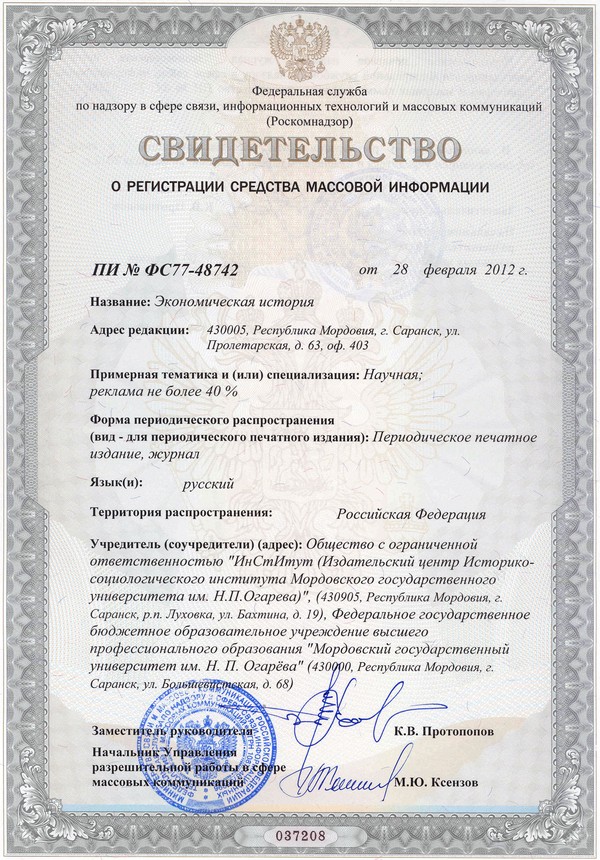
Certificate of registration
Expert board:
- Scientific Council of RAS on economic history;
- Research and Educational Center «The economic history of Central Russia and the Middle Volga region» of Ogarev Mordovia State University;
- Center of Economic History of Lomonosov Moscow State University
Navigation
ISSN 2409-630X (Print), ISSN 2618-916X (Online)
DOI: 10.24412/2409-630X.072.022.202601.036-047
УДК 947:621.311.25(571.62)»198/199»
Nikolay S. Vorontsov
Institute of History, Archaeology and Ethnology of the Peoples of the Far East, FEB RAS (Vladivostok, Russia),
e-mail: nsv91@yandex.ru
The Selection of a Site for a Nuclear Power Plant in Khabarovsk Krai: the Historical Experience of Design and Survey Work in the 1980–1990s
Abstract
Introduction. The article examines the process of selecting a site for the construction of the Komsomolsk (Far Eastern) Nuclear Power Plant in the Khabarovsk Krai in the late 1980s and early 1990s. The relevance of the study is driven by the revival of state interest in developing nuclear energy in the region and the need to consider historical experience when implementing modern large-scale energy construction projects.
Materials and Methods. The research is based on a corpus of previously unpublished archival documents from the holdings of regional, local, and departmental archives: minutes of meetings, reports from organizations involved in the surveys, interdepartmental correspondence, and materials covering various aspects of the survey and design work. The historical-systemic and comparative-historical methods were used to analyze the progress of the surveys, site selection criteria, and interaction among project participants.
Results. The study identified the range of organizations and specialists involved in the site selection process for the nuclear power plant after the new requirements for NPP siting were adopted in 1987. It demonstrates how a multifactor analysis of seismic, hydrological, logistical, environmental, and other conditions led to the selection of the “Amgun-2” site in the Solnechny District out of numerous considered options. The key factors for this choice were its remoteness from major population centers, relatively favorable seismic-tectonic conditions, the possibility of creating a reservoir for the cooling system, and proximity to the BAM transport infrastructure. The primary reasons that complicated and ultimately halted the project’s implementation are highlighted: strong public opposition and a sharp reduction in funding amid the systemic crisis of the early 1990s.
Discussion and Conclusion. The survey and design work of the late 1980s represent a unique experience in assessing vast territories for their suitability for NPP siting in accordance with strict regulations adopted after the Chernobyl disaster. Despite the technical justification for selecting the “Amgun-2” site, the project encountered insurmountable socio-political and economic barriers of the transitional period. The historical experience underscores the importance of considering public perception, economic sustainability, and effective communication with local communities when planning such facilities in the future, including the implementation of the currently discussed Khabarovsk NPP project.
Keywords: Far East, nuclear power, Far Eastern NPP, Khabarovsk NPP, site selection, Khabarovsk Krai, survey work, public protest, Atomenergoproekt.
For citation: Vorontsov N. S. The Selection of a Site for a Nuclear Power Plant in Khabarovsk Krai: the Historical Experience of Design and Survey Work in the 1980–1990s. Ekonomicheskaya istoriya = Russian Journal of Economic History. 2026; 22(1): 36–47. (In Russ.) DOI: 10.24412/2409-630X.072.022.202601.036-047.
© Ogarev Mordovia State University. History and Sociology Institute, 2017
68, Of. 411, Bolshevistskaya St., 430005, The editorial office of the scholarly journal «Russian Journal of Economic History»
Tel.: (8342) 24-25-90; 27-07-11, Fax: (8342) 24-25-90, E-mail: jurnal-econom-hist@isi.mrsu.ru
Designed by A. Napalkov, Email: napalkov@isi.mrsu.ru