Экономическая историЯ
Russian Journal of Economic History
ISSN 2409-630X (Print)
ISSN 2618-916X (Online)

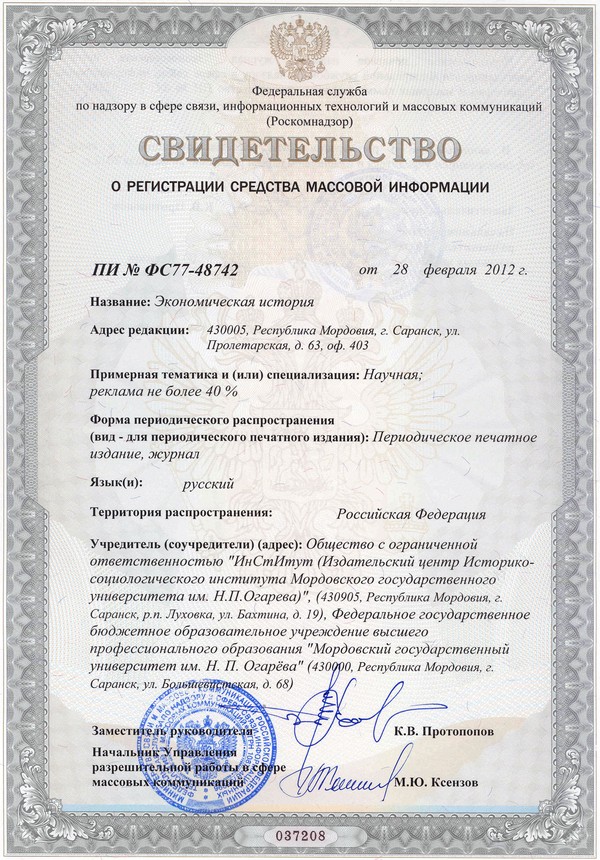
Certificate of registration
Expert board:
- Scientific Council of RAS on economic history;
- Research and Educational Center «The economic history of Central Russia and the Middle Volga region» of Ogarev Mordovia State University;
- Center of Economic History of Lomonosov Moscow State University
Navigation
ISSN 2409-630X (Print), ISSN 2618-916X (Online)
DOI: 10.24412/2409-630X.072.022.202601.061-073
УДК 908.470
Sergey V. Pershin1, Alina O. Lavrushkina2, Sergey N. Pershin3
1 Scientific Research Institute of Humanitarian Sciences under the Government of the Republic of Mordovia; National Research Ogarev Mordovia State University, (Saransk, Russia),
e-mail: pers99@inbox.ru
2 Education Center No. 15 “Height” named after Hero of the Soviet Union M. P. Devyatayev (Saransk, Russia),
e-mail: agulnyashkina@yandex.ru
3 Scientific Research Institute of Humanitarian Sciences under the Government of the Republic of Mordovia (Saransk, Russia),
e-mail: serp201@yandex.ru
“The Giver’s Hand Will not Fail”: the Role of Benefactors in Financing Poor Pupils of Theological Educational Institutions of the Smolensk Diocese in the Last Quarter of the XIX – early XX centuries
Abstract
Introduction. Despite the extensive regional historiography of the problem of the formation of spiritual education (first of all, the works of I. Speransky, P. V. Caesarevsky, Hieromonk Seraphim (Amelchenkov), N. Y. Naletova, N. A. Mitsuk should be mentioned here), publications devoted to the financing of educational institutions of the Russian Orthodox Church are still missing. The authors of the article presented to the readers set out to consider the forms of financial assistance to pupils of religious educational institutions.
Materials and Methods. The article’s source base is based on materials from the Smolensk Diocesan Gazette periodical and data from the archives of the Smolensk Region State Archive and the Russian State Historical Archive. In the course of the work, historical-genetic, historical-comparative, historical-systemic, problem-chronological and statistical methods were used.
Results and Discussion. As a result of the study, it was found that the main forms of financial support for poor students were, firstly, nominal scholarships, secondly, voluntary donations from individuals, and thirdly, societies for helping poor students. The class character of charity is evidenced by the fact that the recipients of the money were mostly children from the families of parish priests and clergymen, and patrons and trustees primarily came from the same provincial clergy.
Conclusion. Through scholarships and one-time donations, low-income students received real assistance that allowed them to complete their studies at colleges and seminaries. Despite the difficult times experienced by the Orthodox clergy in the first decades of the twentieth century, they did not abandon the material support of those in need. In the Smolensk diocese, there were Societies for the relief of poor pupils of the diocesan Women’s Theological school, the Belsky Theological School and the Theological seminary.
Keywords: charity, trusteeship, scholarship, clergy, Russian Orthodox Church, diocese, seminary, theological college, Smolensk region.
For citation: Pershin S. V., Lavrushkina A.O., Pershin S. N. “The Giver’s Hand Will not Fail”: the Role of Benefactors in Financing Poor Pupils of Theological Educational Institutions of the Smolensk Diocese in the Last Quarter of the XIX – early XX centuries. Ekonomicheskaya istoriya = Russian Journal of Economic History. 2026; 22(1): 61–73. (In Russ.) DOI: 10.24412/2409-630X.072.022.202601.061-073.
© Ogarev Mordovia State University. History and Sociology Institute, 2017
68, Of. 411, Bolshevistskaya St., 430005, The editorial office of the scholarly journal «Russian Journal of Economic History»
Tel.: (8342) 24-25-90; 27-07-11, Fax: (8342) 24-25-90, E-mail: jurnal-econom-hist@isi.mrsu.ru
Designed by A. Napalkov, Email: napalkov@isi.mrsu.ru